More insights.
Abstract
In recent years, Japanese kaidan (ghost story) culture has gained increasing recognition on the global stage. Once localized as folklore meant to inspire fear or explain misfortunes and diseases, yōkai—the supernatural entities that inhabit these tales—have gradually transformed from the objects of fear into icons of creative expression. Through literature, fine art, film, anime, and popular culture, yōkai have evolved into complex symbols of both historical trauma and modern imagination. Today, kaidan represents not merely a genre of storytelling, but a culturally embedded and uniquely Japanese form of symbolic communication, ritual memory, and aesthetic transgression.
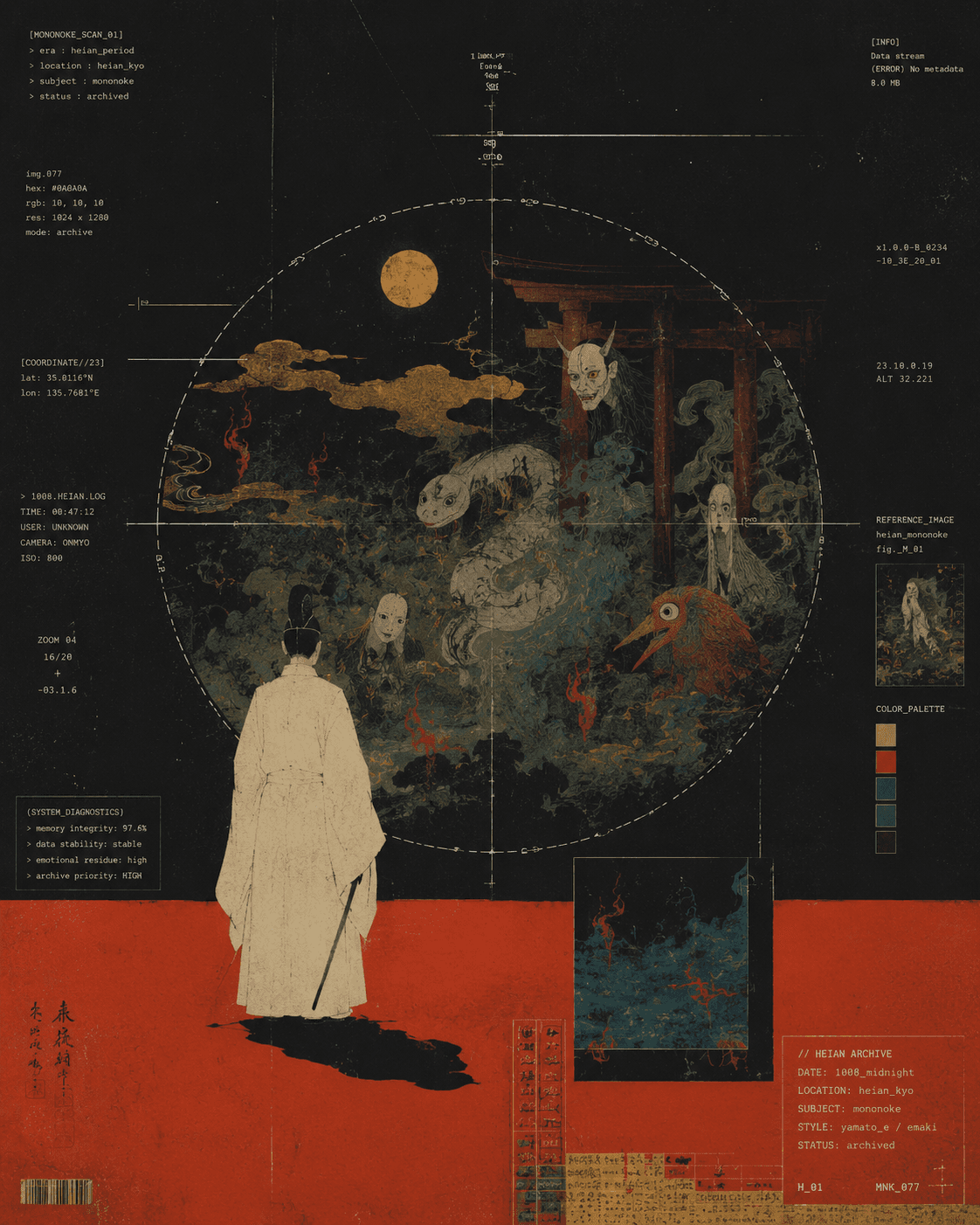
Among the diverse expressions of yōkai culture, the concept of Hyakki Yagyō (百鬼夜行) commonly translated as “The Night Parade of One Hundred Demons”, holds a central and emblematic position. The term describes a legendary phenomenon in which a procession of spirits, monsters, and haunted objects march through the streets at night, causing chaos and disorder. Originating as a literary and artistic motif, it has since become one of the most recognizable symbols of Japan’s supernatural heritage. The image of hundreds of spectral beings parading through the night encapsulates the core tensions of Japanese folk spirituality: between purity and pollution, order and chaos, life and the afterlife.
Interestingly, this night parade is almost always depicted as passing through Heian-kyō, the ancient capital of Japan (present-day Kyoto). This paper investigates why Heian-kyō is so inextricably linked to the idea of the Hyakki Yagyō, and how the unique historical, religious, and social context of the Heian period (794–1185) helped cultivate and legitimize this cultural motif.
During the Heian period, Japan experienced a flourishing of aristocratic culture, the consolidation of political power in Kyoto, and a simultaneous surge in esoteric Buddhism (mikkyō), Onmyōdō (陰陽道, the way of yin and yang), and native animistic beliefs. These religious and cosmological systems provided fertile ground for the creation and propagation of stories involving spiritual possession, curses, ghosts, and supernatural phenomena. In this context, yōkai and haunted artifacts (tsukumogami) emerged as both metaphors and mediators of cultural anxieties, about political instability, spiritual corruption, disease, natural disasters, and death.
The emergence of Hyakki Yagyō in the cultural memory of Heian-kyō can also be read through the lens of urban fear. As the capital grew in size and complexity, so too did the fear of contamination, both literal (in the form of epidemics and fires) and spiritual (in the form of onryō, or vengeful spirits). The formal, symmetrical layout of Heian-kyō, designed according to Chinese geomantic principles (feng shui), was meant to ensure harmony between human society and the cosmos. Yet beneath this spatial order lingered disorder—an underworld of neglected spirits, discarded objects, and liminal creatures that could erupt into the night in violent, chaotic processions. The Hyakki Yagyō thus symbolizes both a disruption of human order and a return of what society tries to repress: the forgotten, the unwanted, and the spiritually unfulfilled.
This paper proceeds along two primary lines of inquiry. First, it explores the social, historical, and geographical conditions that allowed Heian-kyō to become the symbolic site of yōkai emergence. Second, it analyzes how the Hyakki Yagyō functions as a cultural mirror of the Heian period, reflecting its spiritual worldview, political atmosphere, artistic practices, and cosmological logic. By tracing the confluence of historical trauma, ritual systems, and aesthetic innovation, this study seeks to demonstrate that Heian-kyō did not merely house supernatural culture, but actively shaped its development.
The paper is organized into the following structure. Chapter One investigates the environmental, religious, and urban factors that positioned Heian-kyō as a cradle of yōkai narratives. Chapter Two focuses on the iconography and mythology of the Hyakki Yagyō, analyzing how it reflects the cosmology and moral universe of the Heian aristocracy. Through this dual approach, the paper argues that Japanese kaidan culture—especially as symbolized by the Hyakki Yagyō, cannot be separated from the physical and metaphysical structure of Heian-kyō itself.
Keywords: Heian Period, Heian-kyō, Hyakki Yagyō, Yōkai Culture, Japanese Folklore, Onmyōdō, Buddhism, Urban Ghost Stories, Tsukumogami
1. Heian-kyō and the Haunted Cosmos — The Origins of Kaidan Culture in Japan
Japanese kaidan (ghost story) culture is not merely a genre of entertainment, but a cultural phenomenon with a rich and multilayered history spanning over a millennium. Its roots stretch back to Japan’s ancient interactions with mainland Asia, where religious, philosophical, and artistic ideas flowed across borders and shaped the Japanese worldview. Beginning in the Nara period (710–794), Japan actively absorbed elements from Chinese Tang dynasty culture and Indian religious cosmology, primarily through the transmission of Buddhism. Alongside sacred scriptures and temple architecture came a flood of mythological beings, demons, spirits, and celestial creatures, which were interpreted and reconfigured within the Japanese imagination.
Among the most impactful of these imports was the concept of the oni (鬼), often translated as "demon" or "ogre" but more accurately understood as a hybrid of ancestral ghost, malevolent force, and karmic punisher. Initially portrayed as grotesque figures with horns, fangs, and monstrous appetites, oni were not simply fantasy monsters. They represented misfortune, pestilence, natural disaster, and karmic retribution. Over time, however, these figures evolved from symbols of terror into cultural archetypes, capable of reflecting societal fears, moral transgressions, and unspoken desires.
It was during the Heian period (794–1185) that this evolution accelerated and took on distinctively Japanese forms. As the newly established capital of Heian-kyō (modern-day Kyoto) became the epicenter of political power, literary production, and religious experimentation, it also became the cradle of supernatural imagination. Within the elite courtly milieu, where aesthetics, poetry, and ritualized behavior were central to everyday life, supernatural occurrences, such as ghost sightings, spiritual possession, and unexplained illness, were often interpreted through lenses of karmic causality and cosmological imbalance.
This period saw the fusion of imported Buddhist metaphysics and native animistic traditions, giving rise to uniquely Japanese interpretations of the supernatural. Yōkai (妖怪)a term encompassing a broad array of monsters, spirits, and strange phenomena, emerged as a central category in these cultural narratives. They were often seen as liminal beings, existing on the boundaries between the sacred and the profane, the natural and the spiritual, the past and the present. Kaidan culture, in this context, became a means of both storytelling and spiritual reckoning, a poetic system through which the unknown could be named, embodied, and ultimately understood.
By the Muromachi period (1336–1573), kaidan culture had fully matured and began to flourish not only in oral tradition but also in visual art. One of the most significant milestones in the visual history of yōkai culture was the creation of the Hyakki Yagyō Emaki (Night Parade of One Hundred Demons Picture Scroll), attributed to Tosa Mitsunobu (土佐光信), a court painter of the Ashikaga shogunate. These illustrated scrolls offered vivid depictions of supernatural beings parading through the night, each creature representing a distorted reflection of human folly, spiritual neglect, or social disorder. This artistic tradition would go on to influence generations of Japanese painters, storytellers, and folklorists.
The significance of the Hyakki Yagyō motif lies not only in its visual imagination but also in its symbolic geography. According to most versions of the legend, the night parade proceeds through the ancient capital of Heian-kyō. This is not coincidental. Heian-kyō, with its symmetrical streets, sacred mountains, and imperial institutions, represented not just the political heart of Japan but also its spiritual nervous system. As such, the passage of demons through its streets symbolized more than nocturnal mischief, it signaled the rupture of cosmic balance, the return of the repressed, and the haunting of state authority by its own past.
Thus, we can begin to see the Heian period not merely as a backdrop for yōkai culture, but as its generative core. The combination of spiritual anxiety, environmental disasters, and strict social hierarchy created fertile conditions for the emergence of kaidan as a structured genre. Moreover, the geographical and cosmological significance of Heian-kyō positioned it as the perfect stage upon which the demons of the Hyakki Yagyō could perform their nocturnal ritual.
This paper will examine in depth how the historical conditions of the Heian period, its politics, religion, literature, and urban structure, gave rise to a unique form of supernatural expression that still resonates in contemporary Japanese culture. By situating the development of kaidan within the broader context of Japan’s religious and aesthetic traditions, we can better understand why the night parade of demons, and the city it traverses, remain enduring symbols of the Japanese imagination.
2. Heian-kyō as the Cradle of Yōkai Culture
2.1 The Emergence of Tsukumogami and the Origins of Hyakki Yagyō
In the rich tapestry of Japanese folklore, the concept of tsukumogami, tools and household objects that acquire a spirit after a hundred years, stands out as a unique manifestation of animistic beliefs. One of the earliest literary references to tsukumogami appears in the otogizōshi (companion tales) genre, particularly in the story "Tsukumogami-ki." This narrative describes how, during the annual housecleaning, old and discarded items, imbued with a sense of resentment from being abandoned, transform into yōkai. These transformed objects gather and parade through the streets of Heian-kyō at night, causing mischief and chaos. This procession is considered a precursor to the Hyakki Yagyō, or "Night Parade of One Hundred Demons," a motif that has become central to Japanese supernatural lore.
The tale reflects a broader cultural sentiment: a deep respect for objects and the belief that neglecting or discarding them improperly could lead to spiritual repercussions. This belief system underscores the interconnectedness between humans and the material world, suggesting that even inanimate objects possess a form of consciousness or spirit.
2.2 Heian-kyō's Unique Historical and Geographical Conditions
The selection of Heian-kyō (modern-day Kyoto) as the imperial capital in 794 CE by Emperor Kanmu was influenced by both political and spiritual considerations. The move aimed to distance the court from the growing influence of Buddhist institutions in Nara and to establish a new center that embodied both political authority and spiritual harmony.
Heian-kyō was meticulously planned based on Chinese geomantic principles, particularly the concept of shijin sōō (四神相応), which dictates that a city should be protected by four guardian deities corresponding to the cardinal directions: Genbu (Black Tortoise) to the north, Suzaku (Vermilion Bird) to the south, Seiryū (Azure Dragon) to the east, and Byakko (White Tiger) to the west. Geographically, Heian-kyō was flanked by Mount Funaoka to the north, the Kamo River to the east, the Katsura River to the west, and faced the Ogura Pond to the south, aligning with these protective deities.
Despite these auspicious designs, the city was not immune to natural disasters, political strife, and outbreaks of disease. Such events were often interpreted as manifestations of spiritual imbalance or the wrath of neglected deities and spirits. The prevalence of onryō (vengeful spirits) in Heian-period literature and the establishment of rituals to appease these entities highlight the era's preoccupation with maintaining spiritual equilibrium.
2.3 The Role of Religious Syncretism in Yōkai Proliferation
The Heian period was marked by a complex interplay of religious beliefs, including Shinto, Buddhism, and Taoism. This syncretism contributed to a rich spiritual landscape where various deities, spirits, and supernatural beings coexisted. The integration of Onmyōdō (the Way of Yin and Yang), a system of cosmology and divination, further influenced the perception and categorization of supernatural phenomena.
Onmyōji, practitioners of Onmyōdō, played a crucial role in court affairs, advising on matters ranging from astrology to exorcisms. Their presence underscores the importance placed on spiritual matters and the belief that unseen forces could directly impact the physical world. The rituals and practices of Onmyōdō, combined with the narratives of yōkai and other supernatural entities, reflect a society deeply attuned to the metaphysical dimensions of existence.
2.4 Heian-kyō as a Nexus of Supernatural Activity
Given its status as the political and cultural heart of Japan, Heian-kyō naturally became a focal point for stories of supernatural occurrences. The city's structured layout, juxtaposed with the unpredictable nature of spiritual phenomena, created a dynamic backdrop for tales of yōkai and otherworldly events. The Hyakki Yagyō, in particular, symbolizes the intrusion of the supernatural into the human realm, challenging the established order and reminding inhabitants of the ever-present spiritual forces surrounding them.
The belief in tsukumogami and the narratives of their nocturnal processions through Heian-kyō serve as metaphors for societal anxieties, including fears of disorder, the consequences of neglect, and the impermanence of material possessions. These stories not only entertained but also conveyed moral lessons, emphasizing the importance of respect, mindfulness, and harmony with the spiritual world.
3. The Hyakki Yagyō as a Reflection of Heian-kyō's Unique Characteristics
3.1 Buddhism and Onmyōdō: Spiritual Foundations of the Supernatural
The Heian period (794–1185) was a time of profound religious and cultural development in Japan. Buddhism, having been introduced from China and Korea, had firmly established itself within the aristocracy, influencing art, literature, and daily life. Esoteric sects like Shingon and Tendai gained prominence, emphasizing complex rituals and the pursuit of enlightenment through mystical practices. Simultaneously, Onmyōdō, a syncretic system combining elements of Taoism, Buddhism, and indigenous Shinto beliefs, became institutionalized within the imperial court. Onmyōji, practitioners of Onmyōdō, were responsible for divination, exorcisms, and maintaining the spiritual balance of the state.
The Hyakki Yagyō, or "Night Parade of One Hundred Demons," can be seen as a manifestation of these religious and philosophical currents. The procession of yōkai through the streets of Heian-kyō symbolizes the permeable boundary between the spiritual and physical realms. Many of the yōkai depicted in the Hyakki Yagyō are tsukumogami, objects that have acquired a spirit after a hundred years of existence. This belief reflects the Buddhist concept of animism, where all things possess a spiritual essence, and the idea that neglecting or discarding objects without proper rituals can lead to spiritual consequences.
Specific yōkai from the Hyakki Yagyō, such as the kimonoke (a spirit of discarded clothing) or the chōchin-obake (a haunted lantern), illustrate how everyday items were believed to transform into supernatural entities. These tales served as moral lessons, emphasizing respect for possessions and the importance of ritual purity. They also reflect the Heian period's intricate relationship with material culture and the spiritual significance attributed to objects.
3.2 Tsukumogami and the Cultural Significance of Objects
The concept of tsukumogami is deeply rooted in the Heian period's cultural and economic context. During this time, Japan engaged in active trade with China, importing luxury goods such as silk, ceramics, and religious artifacts. These items were highly valued, and their accumulation signified wealth and status. However, the influx of foreign goods also led to a culture of consumption and, eventually, neglect of older possessions.
The belief that neglected objects could become tsukumogami served as a cautionary tale against wastefulness and disrespect. It reinforced the idea that all things, animate or inanimate, deserved reverence. This perspective is evident in stories where tsukumogami, feeling abandoned, seek revenge on their former owners. Such narratives highlight the moral and spiritual responsibilities individuals had toward their belongings.
Moreover, the depiction of tsukumogami in art and literature, particularly in emakimono (illustrated scrolls), reflects the Heian period's aesthetic sensibilities. These scrolls not only entertained but also conveyed complex religious and philosophical ideas, blending visual artistry with moral instruction. The Hyakki Yagyō emaki, for instance, serves as both a catalog of yōkai and a commentary on the consequences of human actions.
3.3 The Interplay of Religion, Politics, and Supernatural Beliefs
In the Heian period, the relationship between religious cosmology and political authority was not merely symbolic, it was functional, structural, and foundational. The imperial state depended upon ritual specialists such as Onmyōji not only to perform exorcisms or read celestial omens, but to actively shape political legitimacy through invisible frameworks. Their practices constituted a metaphysical infrastructure, wherein the correct alignment of celestial, terrestrial, and spiritual forces was believed to reflect, and ensure, the health of the nation.
This alignment was not abstract. Natural disasters, plagues, and even mysterious deaths among the nobility were treated as breaches in this delicate balance. The court responded not just with policy, but with elaborate ritual interventions: the summoning of Buddhist monks, the recitation of sutras, the sealing of restless spirits, and the periodic relocation of capitals when malign influences were thought irreparable. In this system, Onmyōdō operated like an epistemic technology, a means of interpreting and managing uncertainty through codified rites, geomancy, and calendar control. The practice of determining “days of misfortune” (yakubyō) or redirecting funerary processions to avoid spiritual contamination exemplifies how everyday governance was saturated with esoteric calculations.
The Hyakki Yagyō, typically depicted as an uncontrollable parade of demons and ghostly figures, was more than folklore. It embodied a latent fear of what happened when spiritual neglect, political corruption, or ritual disorder accumulated beyond repair.
The idea that unseen, discarded, or dishonored forces could erupt into the visible world paralleled anxieties over class inversion, rebellion, or the collapse of central authority. The procession thus became a warning: not just of ghosts, but of governance gone awry. In visual art, its passage through Kyoto’s recognizable cityscapes was no accident, it served as a spiritual map of the capital’s psychic vulnerabilities.
Moreover, the proliferation of yōkai stories during this period reveals not merely a fascination with the monstrous, but a calculated diffusion of ideology. Tales of tsukumogami, ordinary objects turned vengeful after being abandoned, reinforced frugality, humility, and the Confucian ethic of “care for what is inherited.” They also subtly warned against challenging the social order: those who upset harmony, who disrespected hierarchy or neglected rites, could invite not just social punishment, but supernatural retaliation.
Importantly, this system worked both from the top down and the bottom up. While the imperial court used religious orthopraxy to consolidate rule, popular beliefs and local practices also shaped the imagination of power. Pilgrimage sites, local spirit cults, and vernacular festivals often existed in ambiguous tension with formal court rites. Rather than suppressing them, the state often appropriated or regularized them, blurring the boundary between public governance and private belief. In doing so, it reinforced its reach not just over bodies, but over dreams, fears, and metaphysical narratives.
Thus, the Heian worldview did not distinguish religion, politics, and the supernatural as separate domains. Rather, they formed a seamless continuum in which legitimacy, ritual efficacy, and cosmological harmony were interdependent. The supernatural was not the Other of the rational, it was a mechanism through which rational order was imagined, stabilized, and at times, violently enforced.
4. Conclusion: Understanding Heian Japan Through Kaidan Culture
The supernatural imagination that flourished during the Heian period was not a mere flight of fantasy, nor was it simply a reflection of religious superstition. Rather, it emerged from a distinct historical, cultural, and psychological environment, one that was shaped by political consolidation, spiritual anxiety, rapid urbanization, and evolving aesthetic sensibilities. Within this framework, kaidan (ghost stories) and yōkai narratives became crucial cultural tools: they encoded the fears, moral systems, and cosmological views of the people who produced them.
As we have seen through the exploration of Hyakki Yagyō—the “Night Parade of One Hundred Demons”such stories offered more than entertainment. They were symbolic commentaries on disorder, decay, and the collapse of balance between the human world and the spiritual realm. Each yōkai, especially the tsukumogami, carried with it layered meanings, about waste, memory, ritual neglect, and the animistic logic that underpinned everyday life in Heian-kyō. These supernatural beings emerged not only from religious traditions like Buddhism and Onmyōdō, but also from the deep structure of Heian society itself: its obsession with order and cleanliness, its strict codes of propriety, and its underlying fear of contamination, both physical and metaphysical.
By investigating the cultural logic of the Hyakki Yagyō, we gain insight into how people of the Heian period perceived the invisible forces that governed their world. The kaidan tradition allows us to glimpse their cosmology: a world where objects had spirits, where improper behavior could summon vengeance from the dead, and where cities themselves could be haunted by their own histories. These beliefs were not marginal, they were woven into political rituals, literary works, and artistic expressions.
Moreover, kaidan culture did not remain static. As it moved through the ages, from the Heian into the Muromachi, Edo, and modern periods, it absorbed new fears and reframed old narratives. Yet even in contemporary Japan, the Hyakki Yagyō remains a powerful image, invoked in manga, films, and summer ghost festivals, reminding modern audiences of the deep continuity between Japan’s historical past and its present cultural psyche.
Through the study of these narratives, we do not merely learn about ghosts and monsters, we learn about how a civilization imagines the consequences of human action, the limits of order, and the meaning of transgression. The Hyakki Yagyō and the broader kaidan tradition offer us an invaluable window into the soul of the Heian era: its elegance, its terrors, its contradictions, and its persistent belief that beauty and horror often walk hand in hand.
Moreover, the study of Hyakki Yagyō as an evolving cultural motif opens space for future comparative studies. Similar processions of spirits or festivals of the dead can be found in other cultures, from the Mexican Día de los Muertos to Western ghost walks and All Hallows’ Eve. These analogs reveal that humanity across time and place has used supernatural narratives to manage social fears, encode memory, and express collective emotions. In this light, Hyakki Yagyō is not only a Japanese phenomenon, but also part of a universal human effort to render the invisible visible and give form to the unknown.
In conclusion, kaidan culture, especially as represented by the Hyakki Yagyō, serves as both mirror and map. It reflects the cultural anxieties of the Heian period while also guiding us toward a deeper understanding of Japan’s historical imagination. To study these ghostly parades is to enter into dialogue with the spirits of the past, and in doing so, we come to understand not only their world, but also our own.
While rooted in ancient beliefs and Heian-period cosmology, the legacy of Hyakki Yagyō continues to shape Japanese cultural expressions today. Far from being a relic of myth, the imagery of the night parade persists in modern manga, anime, and film, notably in works such as GeGeGe no Kitarō, Natsume's Book of Friends, and Studio Ghibli’s Spirited Away. These narratives often portray yōkai not as simple villains but as complex figures, embodying loneliness, miscommunication, or historical trauma. In this way, contemporary media revives the kaidan tradition not only through aesthetic borrowing but also through thematic continuity.
The popularity of yōkai festivals, haunted attractions, and merchandise further demonstrates how these once-feared beings have become domesticated within a consumer culture. Yet, their core function remains intact: to visualize the intangible, give shape to anxiety, and narrate the boundary between order and disruption. In academic discourse, scholars such as Michael Dylan Foster and Noriko Reider have analyzed how yōkai operate as ‘cultural categories’, fluid, adaptive, and deeply embedded in national memory.
The continued relevance of Hyakki Yagyō suggests that Japanese society has not discarded its supernatural past but rather transformed it into a dynamic resource for creativity and identity. As Japan navigates contemporary challenges, urban alienation, environmental loss, technological overreachl, the figure of the yokai offers both critique and comfort. It reminds us that disorder, when acknowledged rather than suppressed, can become a space of narrative possibility.
Thus, the ghostly procession first imagined in Heian-kyō continues to walk, not just through ancient scrolls but across screens, stages, and city streets. It calls on each generation to reconsider what haunts them, and how those hauntings might be expressed, exorcised, or embraced.
Bibliography
Bathgate, Michael. The Fox's Craft in Japanese Religion and Folklore: Shapeshifters, Transformations and Duplicities. New York: Routledge, 2004.
Foster, Michael Dylan. Pandemonium and Parade: Japanese Monsters and the Culture of Yōkai. Berkeley: University of California Press, 2009.
Rambelli, Fabio. “Secrecy in Japanese Esoteric Buddhism.” Japanese Journal of Religious Studies 36, no. 1 (2009): 21–47.
Reider, Noriko T. Japanese Demon Lore: Oni from Ancient Times to the Present. Logan: Utah State University Press, 2010.
Sakamoto, Tarō. A General Overview of Japanese History. Beijing: Commercial Press, 1992.
Tyler, Royall. Japanese Tales. New York: Pantheon Books, 1987.
Yamashita, Katsuaki. Discovering Onmyōdō: Heian Aristocrats and the Onmyōji. 2019. ISBN 978-7-5201-3503-0.
Yeh, I-chun. The Illustrated Bestiary of Yōkai. 2006. ISBN 978-957-32-5861-2.
Abstract
In recent years, Japanese kaidan (ghost story) culture has gained increasing recognition on the global stage. Once localized as folklore meant to inspire fear or explain misfortunes and diseases, yōkai—the supernatural entities that inhabit these tales—have gradually transformed from the objects of fear into icons of creative expression. Through literature, fine art, film, anime, and popular culture, yōkai have evolved into complex symbols of both historical trauma and modern imagination. Today, kaidan represents not merely a genre of storytelling, but a culturally embedded and uniquely Japanese form of symbolic communication, ritual memory, and aesthetic transgression.
Among the diverse expressions of yōkai culture, the concept of Hyakki Yagyō (百鬼夜行) commonly translated as “The Night Parade of One Hundred Demons”, holds a central and emblematic position. The term describes a legendary phenomenon in which a procession of spirits, monsters, and haunted objects march through the streets at night, causing chaos and disorder. Originating as a literary and artistic motif, it has since become one of the most recognizable symbols of Japan’s supernatural heritage. The image of hundreds of spectral beings parading through the night encapsulates the core tensions of Japanese folk spirituality: between purity and pollution, order and chaos, life and the afterlife.
Interestingly, this night parade is almost always depicted as passing through Heian-kyō, the ancient capital of Japan (present-day Kyoto). This paper investigates why Heian-kyō is so inextricably linked to the idea of the Hyakki Yagyō, and how the unique historical, religious, and social context of the Heian period (794–1185) helped cultivate and legitimize this cultural motif.
During the Heian period, Japan experienced a flourishing of aristocratic culture, the consolidation of political power in Kyoto, and a simultaneous surge in esoteric Buddhism (mikkyō), Onmyōdō (陰陽道, the way of yin and yang), and native animistic beliefs. These religious and cosmological systems provided fertile ground for the creation and propagation of stories involving spiritual possession, curses, ghosts, and supernatural phenomena. In this context, yōkai and haunted artifacts (tsukumogami) emerged as both metaphors and mediators of cultural anxieties, about political instability, spiritual corruption, disease, natural disasters, and death.
The emergence of Hyakki Yagyō in the cultural memory of Heian-kyō can also be read through the lens of urban fear. As the capital grew in size and complexity, so too did the fear of contamination, both literal (in the form of epidemics and fires) and spiritual (in the form of onryō, or vengeful spirits). The formal, symmetrical layout of Heian-kyō, designed according to Chinese geomantic principles (feng shui), was meant to ensure harmony between human society and the cosmos. Yet beneath this spatial order lingered disorder—an underworld of neglected spirits, discarded objects, and liminal creatures that could erupt into the night in violent, chaotic processions. The Hyakki Yagyō thus symbolizes both a disruption of human order and a return of what society tries to repress: the forgotten, the unwanted, and the spiritually unfulfilled.
This paper proceeds along two primary lines of inquiry. First, it explores the social, historical, and geographical conditions that allowed Heian-kyō to become the symbolic site of yōkai emergence. Second, it analyzes how the Hyakki Yagyō functions as a cultural mirror of the Heian period, reflecting its spiritual worldview, political atmosphere, artistic practices, and cosmological logic. By tracing the confluence of historical trauma, ritual systems, and aesthetic innovation, this study seeks to demonstrate that Heian-kyō did not merely house supernatural culture, but actively shaped its development.
The paper is organized into the following structure. Chapter One investigates the environmental, religious, and urban factors that positioned Heian-kyō as a cradle of yōkai narratives. Chapter Two focuses on the iconography and mythology of the Hyakki Yagyō, analyzing how it reflects the cosmology and moral universe of the Heian aristocracy. Through this dual approach, the paper argues that Japanese kaidan culture—especially as symbolized by the Hyakki Yagyō, cannot be separated from the physical and metaphysical structure of Heian-kyō itself.
Keywords: Heian Period, Heian-kyō, Hyakki Yagyō, Yōkai Culture, Japanese Folklore, Onmyōdō, Buddhism, Urban Ghost Stories, Tsukumogami
1. Heian-kyō and the Haunted Cosmos — The Origins of Kaidan Culture in Japan
Japanese kaidan (ghost story) culture is not merely a genre of entertainment, but a cultural phenomenon with a rich and multilayered history spanning over a millennium. Its roots stretch back to Japan’s ancient interactions with mainland Asia, where religious, philosophical, and artistic ideas flowed across borders and shaped the Japanese worldview. Beginning in the Nara period (710–794), Japan actively absorbed elements from Chinese Tang dynasty culture and Indian religious cosmology, primarily through the transmission of Buddhism. Alongside sacred scriptures and temple architecture came a flood of mythological beings, demons, spirits, and celestial creatures, which were interpreted and reconfigured within the Japanese imagination.
Among the most impactful of these imports was the concept of the oni (鬼), often translated as "demon" or "ogre" but more accurately understood as a hybrid of ancestral ghost, malevolent force, and karmic punisher. Initially portrayed as grotesque figures with horns, fangs, and monstrous appetites, oni were not simply fantasy monsters. They represented misfortune, pestilence, natural disaster, and karmic retribution. Over time, however, these figures evolved from symbols of terror into cultural archetypes, capable of reflecting societal fears, moral transgressions, and unspoken desires.
It was during the Heian period (794–1185) that this evolution accelerated and took on distinctively Japanese forms. As the newly established capital of Heian-kyō (modern-day Kyoto) became the epicenter of political power, literary production, and religious experimentation, it also became the cradle of supernatural imagination. Within the elite courtly milieu, where aesthetics, poetry, and ritualized behavior were central to everyday life, supernatural occurrences, such as ghost sightings, spiritual possession, and unexplained illness, were often interpreted through lenses of karmic causality and cosmological imbalance.
This period saw the fusion of imported Buddhist metaphysics and native animistic traditions, giving rise to uniquely Japanese interpretations of the supernatural. Yōkai (妖怪)a term encompassing a broad array of monsters, spirits, and strange phenomena, emerged as a central category in these cultural narratives. They were often seen as liminal beings, existing on the boundaries between the sacred and the profane, the natural and the spiritual, the past and the present. Kaidan culture, in this context, became a means of both storytelling and spiritual reckoning, a poetic system through which the unknown could be named, embodied, and ultimately understood.
By the Muromachi period (1336–1573), kaidan culture had fully matured and began to flourish not only in oral tradition but also in visual art. One of the most significant milestones in the visual history of yōkai culture was the creation of the Hyakki Yagyō Emaki (Night Parade of One Hundred Demons Picture Scroll), attributed to Tosa Mitsunobu (土佐光信), a court painter of the Ashikaga shogunate. These illustrated scrolls offered vivid depictions of supernatural beings parading through the night, each creature representing a distorted reflection of human folly, spiritual neglect, or social disorder. This artistic tradition would go on to influence generations of Japanese painters, storytellers, and folklorists.
The significance of the Hyakki Yagyō motif lies not only in its visual imagination but also in its symbolic geography. According to most versions of the legend, the night parade proceeds through the ancient capital of Heian-kyō. This is not coincidental. Heian-kyō, with its symmetrical streets, sacred mountains, and imperial institutions, represented not just the political heart of Japan but also its spiritual nervous system. As such, the passage of demons through its streets symbolized more than nocturnal mischief, it signaled the rupture of cosmic balance, the return of the repressed, and the haunting of state authority by its own past.
Thus, we can begin to see the Heian period not merely as a backdrop for yōkai culture, but as its generative core. The combination of spiritual anxiety, environmental disasters, and strict social hierarchy created fertile conditions for the emergence of kaidan as a structured genre. Moreover, the geographical and cosmological significance of Heian-kyō positioned it as the perfect stage upon which the demons of the Hyakki Yagyō could perform their nocturnal ritual.
This paper will examine in depth how the historical conditions of the Heian period, its politics, religion, literature, and urban structure, gave rise to a unique form of supernatural expression that still resonates in contemporary Japanese culture. By situating the development of kaidan within the broader context of Japan’s religious and aesthetic traditions, we can better understand why the night parade of demons, and the city it traverses, remain enduring symbols of the Japanese imagination.
2. Heian-kyō as the Cradle of Yōkai Culture
2.1 The Emergence of Tsukumogami and the Origins of Hyakki Yagyō
In the rich tapestry of Japanese folklore, the concept of tsukumogami, tools and household objects that acquire a spirit after a hundred years, stands out as a unique manifestation of animistic beliefs. One of the earliest literary references to tsukumogami appears in the otogizōshi (companion tales) genre, particularly in the story "Tsukumogami-ki." This narrative describes how, during the annual housecleaning, old and discarded items, imbued with a sense of resentment from being abandoned, transform into yōkai. These transformed objects gather and parade through the streets of Heian-kyō at night, causing mischief and chaos. This procession is considered a precursor to the Hyakki Yagyō, or "Night Parade of One Hundred Demons," a motif that has become central to Japanese supernatural lore.
The tale reflects a broader cultural sentiment: a deep respect for objects and the belief that neglecting or discarding them improperly could lead to spiritual repercussions. This belief system underscores the interconnectedness between humans and the material world, suggesting that even inanimate objects possess a form of consciousness or spirit.
2.2 Heian-kyō's Unique Historical and Geographical Conditions
The selection of Heian-kyō (modern-day Kyoto) as the imperial capital in 794 CE by Emperor Kanmu was influenced by both political and spiritual considerations. The move aimed to distance the court from the growing influence of Buddhist institutions in Nara and to establish a new center that embodied both political authority and spiritual harmony.
Heian-kyō was meticulously planned based on Chinese geomantic principles, particularly the concept of shijin sōō (四神相応), which dictates that a city should be protected by four guardian deities corresponding to the cardinal directions: Genbu (Black Tortoise) to the north, Suzaku (Vermilion Bird) to the south, Seiryū (Azure Dragon) to the east, and Byakko (White Tiger) to the west. Geographically, Heian-kyō was flanked by Mount Funaoka to the north, the Kamo River to the east, the Katsura River to the west, and faced the Ogura Pond to the south, aligning with these protective deities.
Despite these auspicious designs, the city was not immune to natural disasters, political strife, and outbreaks of disease. Such events were often interpreted as manifestations of spiritual imbalance or the wrath of neglected deities and spirits. The prevalence of onryō (vengeful spirits) in Heian-period literature and the establishment of rituals to appease these entities highlight the era's preoccupation with maintaining spiritual equilibrium.
2.3 The Role of Religious Syncretism in Yōkai Proliferation
The Heian period was marked by a complex interplay of religious beliefs, including Shinto, Buddhism, and Taoism. This syncretism contributed to a rich spiritual landscape where various deities, spirits, and supernatural beings coexisted. The integration of Onmyōdō (the Way of Yin and Yang), a system of cosmology and divination, further influenced the perception and categorization of supernatural phenomena.
Onmyōji, practitioners of Onmyōdō, played a crucial role in court affairs, advising on matters ranging from astrology to exorcisms. Their presence underscores the importance placed on spiritual matters and the belief that unseen forces could directly impact the physical world. The rituals and practices of Onmyōdō, combined with the narratives of yōkai and other supernatural entities, reflect a society deeply attuned to the metaphysical dimensions of existence.
2.4 Heian-kyō as a Nexus of Supernatural Activity
Given its status as the political and cultural heart of Japan, Heian-kyō naturally became a focal point for stories of supernatural occurrences. The city's structured layout, juxtaposed with the unpredictable nature of spiritual phenomena, created a dynamic backdrop for tales of yōkai and otherworldly events. The Hyakki Yagyō, in particular, symbolizes the intrusion of the supernatural into the human realm, challenging the established order and reminding inhabitants of the ever-present spiritual forces surrounding them.
The belief in tsukumogami and the narratives of their nocturnal processions through Heian-kyō serve as metaphors for societal anxieties, including fears of disorder, the consequences of neglect, and the impermanence of material possessions. These stories not only entertained but also conveyed moral lessons, emphasizing the importance of respect, mindfulness, and harmony with the spiritual world.
3. The Hyakki Yagyō as a Reflection of Heian-kyō's Unique Characteristics
3.1 Buddhism and Onmyōdō: Spiritual Foundations of the Supernatural
The Heian period (794–1185) was a time of profound religious and cultural development in Japan. Buddhism, having been introduced from China and Korea, had firmly established itself within the aristocracy, influencing art, literature, and daily life. Esoteric sects like Shingon and Tendai gained prominence, emphasizing complex rituals and the pursuit of enlightenment through mystical practices. Simultaneously, Onmyōdō, a syncretic system combining elements of Taoism, Buddhism, and indigenous Shinto beliefs, became institutionalized within the imperial court. Onmyōji, practitioners of Onmyōdō, were responsible for divination, exorcisms, and maintaining the spiritual balance of the state.
The Hyakki Yagyō, or "Night Parade of One Hundred Demons," can be seen as a manifestation of these religious and philosophical currents. The procession of yōkai through the streets of Heian-kyō symbolizes the permeable boundary between the spiritual and physical realms. Many of the yōkai depicted in the Hyakki Yagyō are tsukumogami, objects that have acquired a spirit after a hundred years of existence. This belief reflects the Buddhist concept of animism, where all things possess a spiritual essence, and the idea that neglecting or discarding objects without proper rituals can lead to spiritual consequences.
Specific yōkai from the Hyakki Yagyō, such as the kimonoke (a spirit of discarded clothing) or the chōchin-obake (a haunted lantern), illustrate how everyday items were believed to transform into supernatural entities. These tales served as moral lessons, emphasizing respect for possessions and the importance of ritual purity. They also reflect the Heian period's intricate relationship with material culture and the spiritual significance attributed to objects.
3.2 Tsukumogami and the Cultural Significance of Objects
The concept of tsukumogami is deeply rooted in the Heian period's cultural and economic context. During this time, Japan engaged in active trade with China, importing luxury goods such as silk, ceramics, and religious artifacts. These items were highly valued, and their accumulation signified wealth and status. However, the influx of foreign goods also led to a culture of consumption and, eventually, neglect of older possessions.
The belief that neglected objects could become tsukumogami served as a cautionary tale against wastefulness and disrespect. It reinforced the idea that all things, animate or inanimate, deserved reverence. This perspective is evident in stories where tsukumogami, feeling abandoned, seek revenge on their former owners. Such narratives highlight the moral and spiritual responsibilities individuals had toward their belongings.
Moreover, the depiction of tsukumogami in art and literature, particularly in emakimono (illustrated scrolls), reflects the Heian period's aesthetic sensibilities. These scrolls not only entertained but also conveyed complex religious and philosophical ideas, blending visual artistry with moral instruction. The Hyakki Yagyō emaki, for instance, serves as both a catalog of yōkai and a commentary on the consequences of human actions.
3.3 The Interplay of Religion, Politics, and Supernatural Beliefs
In the Heian period, the relationship between religious cosmology and political authority was not merely symbolic, it was functional, structural, and foundational. The imperial state depended upon ritual specialists such as Onmyōji not only to perform exorcisms or read celestial omens, but to actively shape political legitimacy through invisible frameworks. Their practices constituted a metaphysical infrastructure, wherein the correct alignment of celestial, terrestrial, and spiritual forces was believed to reflect, and ensure, the health of the nation.
This alignment was not abstract. Natural disasters, plagues, and even mysterious deaths among the nobility were treated as breaches in this delicate balance. The court responded not just with policy, but with elaborate ritual interventions: the summoning of Buddhist monks, the recitation of sutras, the sealing of restless spirits, and the periodic relocation of capitals when malign influences were thought irreparable. In this system, Onmyōdō operated like an epistemic technology, a means of interpreting and managing uncertainty through codified rites, geomancy, and calendar control. The practice of determining “days of misfortune” (yakubyō) or redirecting funerary processions to avoid spiritual contamination exemplifies how everyday governance was saturated with esoteric calculations.
The Hyakki Yagyō, typically depicted as an uncontrollable parade of demons and ghostly figures, was more than folklore. It embodied a latent fear of what happened when spiritual neglect, political corruption, or ritual disorder accumulated beyond repair.
The idea that unseen, discarded, or dishonored forces could erupt into the visible world paralleled anxieties over class inversion, rebellion, or the collapse of central authority. The procession thus became a warning: not just of ghosts, but of governance gone awry. In visual art, its passage through Kyoto’s recognizable cityscapes was no accident, it served as a spiritual map of the capital’s psychic vulnerabilities.
Moreover, the proliferation of yōkai stories during this period reveals not merely a fascination with the monstrous, but a calculated diffusion of ideology. Tales of tsukumogami, ordinary objects turned vengeful after being abandoned, reinforced frugality, humility, and the Confucian ethic of “care for what is inherited.” They also subtly warned against challenging the social order: those who upset harmony, who disrespected hierarchy or neglected rites, could invite not just social punishment, but supernatural retaliation.
Importantly, this system worked both from the top down and the bottom up. While the imperial court used religious orthopraxy to consolidate rule, popular beliefs and local practices also shaped the imagination of power. Pilgrimage sites, local spirit cults, and vernacular festivals often existed in ambiguous tension with formal court rites. Rather than suppressing them, the state often appropriated or regularized them, blurring the boundary between public governance and private belief. In doing so, it reinforced its reach not just over bodies, but over dreams, fears, and metaphysical narratives.
Thus, the Heian worldview did not distinguish religion, politics, and the supernatural as separate domains. Rather, they formed a seamless continuum in which legitimacy, ritual efficacy, and cosmological harmony were interdependent. The supernatural was not the Other of the rational, it was a mechanism through which rational order was imagined, stabilized, and at times, violently enforced.
4. Conclusion: Understanding Heian Japan Through Kaidan Culture
The supernatural imagination that flourished during the Heian period was not a mere flight of fantasy, nor was it simply a reflection of religious superstition. Rather, it emerged from a distinct historical, cultural, and psychological environment, one that was shaped by political consolidation, spiritual anxiety, rapid urbanization, and evolving aesthetic sensibilities. Within this framework, kaidan (ghost stories) and yōkai narratives became crucial cultural tools: they encoded the fears, moral systems, and cosmological views of the people who produced them.
As we have seen through the exploration of Hyakki Yagyō—the “Night Parade of One Hundred Demons”such stories offered more than entertainment. They were symbolic commentaries on disorder, decay, and the collapse of balance between the human world and the spiritual realm. Each yōkai, especially the tsukumogami, carried with it layered meanings, about waste, memory, ritual neglect, and the animistic logic that underpinned everyday life in Heian-kyō. These supernatural beings emerged not only from religious traditions like Buddhism and Onmyōdō, but also from the deep structure of Heian society itself: its obsession with order and cleanliness, its strict codes of propriety, and its underlying fear of contamination, both physical and metaphysical.
By investigating the cultural logic of the Hyakki Yagyō, we gain insight into how people of the Heian period perceived the invisible forces that governed their world. The kaidan tradition allows us to glimpse their cosmology: a world where objects had spirits, where improper behavior could summon vengeance from the dead, and where cities themselves could be haunted by their own histories. These beliefs were not marginal, they were woven into political rituals, literary works, and artistic expressions.
Moreover, kaidan culture did not remain static. As it moved through the ages, from the Heian into the Muromachi, Edo, and modern periods, it absorbed new fears and reframed old narratives. Yet even in contemporary Japan, the Hyakki Yagyō remains a powerful image, invoked in manga, films, and summer ghost festivals, reminding modern audiences of the deep continuity between Japan’s historical past and its present cultural psyche.
Through the study of these narratives, we do not merely learn about ghosts and monsters, we learn about how a civilization imagines the consequences of human action, the limits of order, and the meaning of transgression. The Hyakki Yagyō and the broader kaidan tradition offer us an invaluable window into the soul of the Heian era: its elegance, its terrors, its contradictions, and its persistent belief that beauty and horror often walk hand in hand.
Moreover, the study of Hyakki Yagyō as an evolving cultural motif opens space for future comparative studies. Similar processions of spirits or festivals of the dead can be found in other cultures, from the Mexican Día de los Muertos to Western ghost walks and All Hallows’ Eve. These analogs reveal that humanity across time and place has used supernatural narratives to manage social fears, encode memory, and express collective emotions. In this light, Hyakki Yagyō is not only a Japanese phenomenon, but also part of a universal human effort to render the invisible visible and give form to the unknown.
In conclusion, kaidan culture, especially as represented by the Hyakki Yagyō, serves as both mirror and map. It reflects the cultural anxieties of the Heian period while also guiding us toward a deeper understanding of Japan’s historical imagination. To study these ghostly parades is to enter into dialogue with the spirits of the past, and in doing so, we come to understand not only their world, but also our own.
While rooted in ancient beliefs and Heian-period cosmology, the legacy of Hyakki Yagyō continues to shape Japanese cultural expressions today. Far from being a relic of myth, the imagery of the night parade persists in modern manga, anime, and film, notably in works such as GeGeGe no Kitarō, Natsume's Book of Friends, and Studio Ghibli’s Spirited Away. These narratives often portray yōkai not as simple villains but as complex figures, embodying loneliness, miscommunication, or historical trauma. In this way, contemporary media revives the kaidan tradition not only through aesthetic borrowing but also through thematic continuity.
The popularity of yōkai festivals, haunted attractions, and merchandise further demonstrates how these once-feared beings have become domesticated within a consumer culture. Yet, their core function remains intact: to visualize the intangible, give shape to anxiety, and narrate the boundary between order and disruption. In academic discourse, scholars such as Michael Dylan Foster and Noriko Reider have analyzed how yōkai operate as ‘cultural categories’, fluid, adaptive, and deeply embedded in national memory.
The continued relevance of Hyakki Yagyō suggests that Japanese society has not discarded its supernatural past but rather transformed it into a dynamic resource for creativity and identity. As Japan navigates contemporary challenges, urban alienation, environmental loss, technological overreachl, the figure of the yokai offers both critique and comfort. It reminds us that disorder, when acknowledged rather than suppressed, can become a space of narrative possibility.
Thus, the ghostly procession first imagined in Heian-kyō continues to walk, not just through ancient scrolls but across screens, stages, and city streets. It calls on each generation to reconsider what haunts them, and how those hauntings might be expressed, exorcised, or embraced.
Bibliography
Bathgate, Michael. The Fox's Craft in Japanese Religion and Folklore: Shapeshifters, Transformations and Duplicities. New York: Routledge, 2004.
Foster, Michael Dylan. Pandemonium and Parade: Japanese Monsters and the Culture of Yōkai. Berkeley: University of California Press, 2009.
Rambelli, Fabio. “Secrecy in Japanese Esoteric Buddhism.” Japanese Journal of Religious Studies 36, no. 1 (2009): 21–47.
Reider, Noriko T. Japanese Demon Lore: Oni from Ancient Times to the Present. Logan: Utah State University Press, 2010.
Sakamoto, Tarō. A General Overview of Japanese History. Beijing: Commercial Press, 1992.
Tyler, Royall. Japanese Tales. New York: Pantheon Books, 1987.
Yamashita, Katsuaki. Discovering Onmyōdō: Heian Aristocrats and the Onmyōji. 2019. ISBN 978-7-5201-3503-0.
Yeh, I-chun. The Illustrated Bestiary of Yōkai. 2006. ISBN 978-957-32-5861-2.